
Honolulu Resident Lookup Sources
A one-person search should begin with the record most likely to contain the known fact. Honolulu property records can connect a name to a parcel, while court records connect a party to a case. Vital certificates have strict access rules. Voter information is purpose-limited, and the online voter tool confirms the user's own status. Business and license filings show public affiliations but do not prove a home address.
| Official record | What it may confirm | Honolulu keeper | Access path |
|---|---|---|---|
| RPAD assessment | Fee owner or lessee lead, parcel, site and mailing data | Honolulu RPAD/qPublic | Free web search; not proof of title or occupancy |
| Recorded instruments | Grantor, grantee, parcel link, deed or release | Bureau of Conveyances | Free index; paid images; pre-1976 counter or mail |
| Court case index | Party, case title, court, filing date, type, and status | Hawaii Judiciary eCourt Kōkua | Free index; paid online documents or free terminal |
| Vital and genealogy records | Event, date, place, and relationship when available | Hawaii DOH, HSA, and libraries | Recent copies restricted; older indexes and genealogy routes vary |
| Entity and license filings | Filed role, business status, or professional license status | DCCA HBE and PVL | Free status search; documents or verification may cost |
Use RPAD first when a parcel is central, then verify title through BOC. Use eCourt when a case or filing date is known. For a historical person, shift to directories, census schedules, probate, newspapers, and cemetery indexes. The Hawaii Unclaimed Property owner route can supply a free name lead tied to abandoned financial property, but a claim needs proof and the listing does not establish current residence.
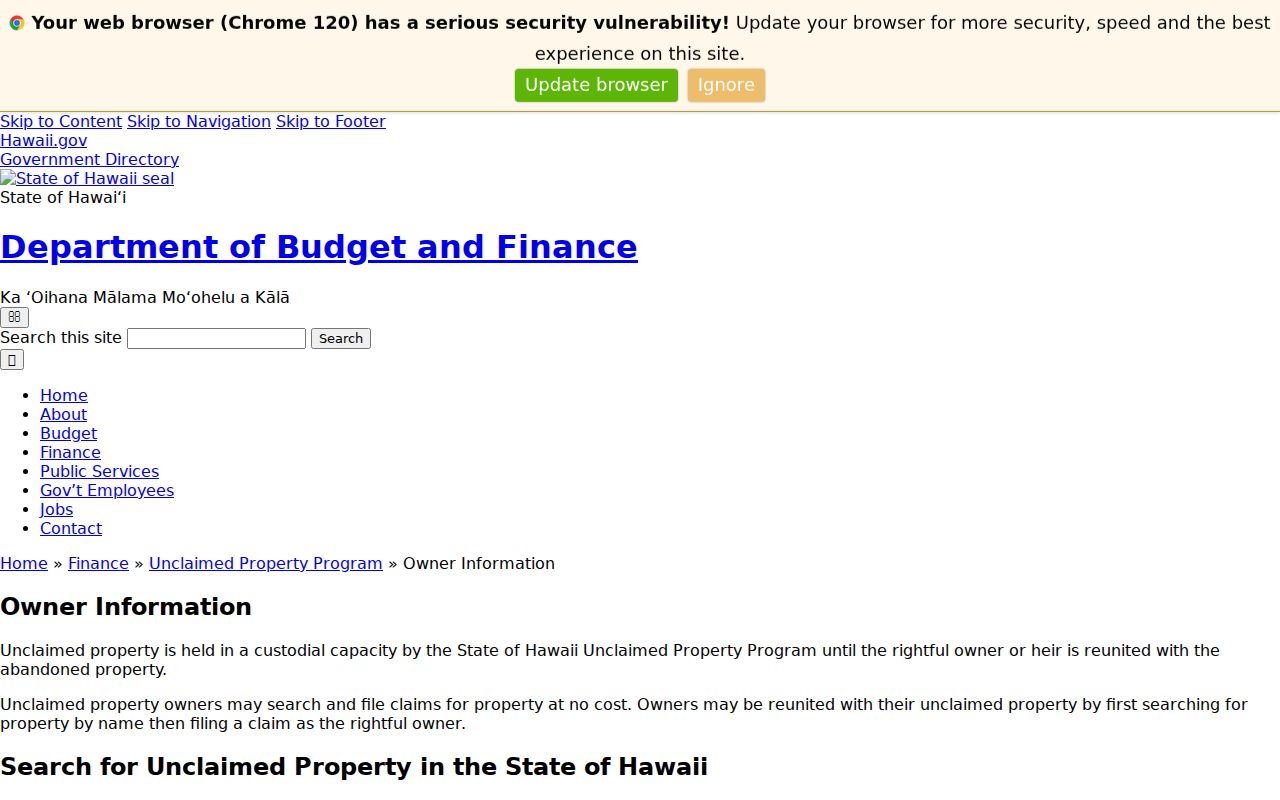
The manifest capture below shows that official owner-information route. It is useful for a name lead, not a current address claim.
Follow the state's claim instructions and do not pay an unsolicited sender to release state-held funds.
Search Honolulu Residents in eCourt
eCourt Kōkua serves the First Circuit and statewide Hawaii courts. Person search requires last and first name, with optional middle name, filing-date range, case type, and partial or phonetic controls. Separate modes accept company name, party ID, case ID or citation number, application number, arrest number, Land Court TCT number, OTN, or SID. Date-only case searches require a court type and are limited to 60 days.
| Search field | Required | Use in a resident lookup |
|---|---|---|
| Last and first name | Yes for person search | Run exact spelling, then a supported partial or phonetic variant. |
| Middle name | No | Helps separate common Honolulu names. |
| Filing dates | No in name mode | Narrows the snapshot; date format is DD-MON-YYYY. |
| Case type | No | Separates civil, criminal, family, land, and other categories. |
| Partial or phonetic | No | Useful for spelling, transliteration, and name-order problems. |
A result may show Case ID, Court, Location, Case Type, Case Title, Filing Date, Status, and a PDF icon when a document is downloadable. No icon can mean the image is unavailable online. It does not prove there is no file. Sealed, juvenile, and confidential matters are withheld, and older online coverage varies by division.
Honolulu Court Lookup Fallbacks
Online search is free, but document access costs money. The Judiciary lists $3 for an online document of 1–30 pages and 10 cents for each later page. A courthouse terminal is free and can be the better fallback. Copies or certification come from the filing court or the First Circuit Legal Documents Branch. The official written request form supports a legal-document or name search when a clear case identifier is available.
Coverage gaps matter. Traffic records before November 1995, district criminal records before August 2012, and appellate matters before September 2010 fall outside listed portal coverage. Older district civil, circuit civil, Land Court, Tax Appeal, and family civil documents also have division-specific online cutoffs. Ask the clerk whether the record exists and whether a terminal, paper file, paid copy, or certified copy is available.
Note: A blank eCourt result may reflect spelling, date coverage, sealing, confidentiality, or image availability rather than no case.
Confirm Honolulu Vital Record Leads
Hawaii vital certificates are not open for general inspection. Under HRS §338-18, a recent certified copy requires direct and tangible interest. Public index data may be authorized, and genealogy access applies to events more than 115 years before the current year. The DOH genealogy route explains appointments, indexes, forms, and proof.
Current birth, death, marriage, and civil-union certificates can be requested online, by mail, or through the Oʻahu office at 1250 Punchbowl Street, Room 103. Eligibility, ID, payment, and relationship documents still apply. As of February 1, 2026, DOH no longer maintains divorce records. Request a divorce file from the court where it was granted, which is usually a First Circuit route for an Oʻahu matter.
A vital index is a lead. It may connect a name to an event, date, place, or relationship. A certified copy is the official copy issued by the custodian, and it has a different access test.
Honolulu Voter Lookup Boundaries
Hawaii Online Voter Registration lets a voter register, update, or confirm the voter's own status. It is not a public search for another Honolulu resident. The online match uses a Hawaii driver license or state ID, last four Social Security number digits, full legal name, birth date, and residence address. A paper or County Elections route applies when the identity match fails.
HRS §§11-14 and 11-97 make full name, district or precinct, status, and authorized address information public within election and government-purpose rules. Sensitive fields are restricted. Hawaii does not register party affiliation, so no official party field belongs in a resident lookup. Protected voters and Address Confidentiality Program participants may have an address shielded.
For the current permitted request path, contact Honolulu County Elections at 530 S. King Street, Room 100, 808-768-3800, or elections@honolulu.gov. Do not treat an inactive status as proof that someone moved, since list maintenance can reflect several events.
Verify Honolulu Resident Records
A sound Honolulu resident lookup needs two independent anchors. Exact name plus TMK, address, filing date, case number, entity name, or vital-event date is stronger than a name alone. Keep the source spelling, including ʻokina and kahakō, then try initials, married or maiden forms, aliases, transliterations, and phonetic controls where the official portal supports them.
- Write the exact name and one known fact, such as an address, TMK, date, court, business, or directory year.
- Search the record tied to that fact. Save the date, role, record number, status, and source URL, not just the person's name.
- Cross-check a second official source. Match the parcel, case, entity, event, or time period before treating two entries as the same person.
- Confirm the role. A grantor, tax owner, court party, agent, officer, or licensee is not automatically an occupant.
- Ask the custodian for an image, certified copy, correction route, or explanation of a lawful restriction when the evidence matters.
- Docket
- The dated list of filings and events in a court case.
- Index versus image
- An index is a searchable summary. An image is the scanned or electronic document, which may cost money or be restricted.
- Certified copy
- An official copy authenticated by the office that keeps the record.
Dates prevent a common error. A current assessment, a decades-old directory, and a probate file describe different moments. A same-name result is never enough by itself.
Honolulu Lookup Paths for Reconnecting
For a former classmate, use HSL's yearbooks, directories, newspapers, and school or alumni archives. For an heir, begin with probate and wills, then pair named relatives with a deed, obituary, cemetery entry, or directory address. A business owner can be checked through Hawaii Business Express and DCCA Professional and Vocational Licensing, but the filed role or business address must not be recast as a home.
Hawaii adoption proceedings are sealed under HRS §578-15. Birth-parent questions must follow the First Circuit or Family Court written-request and court-order process described by official sources. Research found no separate current executive-branch reunion registry that could be promised. DOH access rules cannot be bypassed through a public name search.
The strongest historical path combines records held by different institutions: a yearbook plus a later directory, a newspaper notice plus a vital index, or a deed plus probate. The Honolulu city directory collection is the fuller source for old annual entries.
Request Missing Honolulu Resident Records
The Hawaii Uniform Information Practices Act, HRS chapter 92F, provides a route to a defined government record when the agency keeps it. Send the request to that agency, not to the Office of Information Practices as though it were a repository. State the record type, subject, date range, location, known identifier, inspection or copy format, and contact details. Ask for electronic inspection, a fee estimate, and segregated release of any nonexempt parts.
OIP's request guidance says the ordinary notice or decision framework is 10 business days, though extensions can add time. Rules list search and retrieval at $2.50 per 15 minutes, review and segregation at $5 per 15 minutes, and a first $30 waiver, plus actual copy or postage costs. UIPA does not override vital-record, voter, ACP, sealed-court, DMV, or other confidentiality laws.
If a record is wrong, contact its keeper: RPAD for assessment data, BOC for a recorded-index question, Elections for voter information, DOH for vital amendments, DCCA for filings or licenses, Judiciary for a docket issue, and HSA for a catalog or transcription problem.
Legal Limits on Honolulu Lookups
Public availability does not make every use lawful. HRS §§711-1106 and 711-1106.5 prohibit harassment and harassment by stalking. Repeated unwanted contact, threats, surveillance, intimidation, or exposure of a protected address are not legitimate research. A missing result may reflect sealed family or juvenile files, protected voter status, the Address Confidentiality Program, a portal cutoff, or a record kept only at the counter.
Lawful use. A Honolulu resident lookup is for lawful personal research. Never use a record to stalk, harass, intimidate, or expose a protected person.
Hawaii's Address Confidentiality Program under HRS chapter 801G gives qualified survivors a substitute address, mail forwarding, and service protections. Never try to reverse a substitute address. Commercial compilations may contain stale, merged, or mismatched data; treat that category as an unverified lead and use the official custodian for confirmation.