
Honolulu City Directory Holdings
Honolulu city directories survive in several overlapping runs, beginning with Kingdom-era commercial volumes and continuing through Polk and island editions. No single shelf is complete. The Hawaii State Archives city-directory guide, the Hawaii State Library, UH Mānoa, EVols, and catalog records should be checked together. The core Husted and Polk line spans 1880 through 1987, but publishers, geographic labels, and formats changed. A volume called a Hawaiian, Territory, City and County, or island directory may still contain a useful Honolulu entry.
| Honolulu collection | Years represented | Keeper | Access route |
|---|---|---|---|
| Husted, Polk-Husted, and Polk directories | 1880–1987, with gaps | HSL, HSA, UH, and FamilySearch catalogs | Print, microfilm, catalog leads, and selected scans |
| Street and address listings | 1871–1924 coverage; 1908 index noted | HSL, HSA, and UH | In-person volumes and microfilm |
| Telephone directories | 1894–2001 | Hawaii State Library | Microfiche and hard copy |
| Local census schedules | 1878, partial 1890, limited 1896 | HSA, HSL, and FamilySearch | Finding aids, microfilm, and indexed collections |
HSL identifies Polk microfilm for 1902–1960 and print for 1898–1942, 1947–1949, 1951, and 1953 onward. The gaps in 1943–1946, 1950, and 1952 belong to the holdings record, not necessarily the household. Search the edition before and after a gap, then use a phone book, newspaper, census schedule, or deed. The label also matters. Postwar island directories may distinguish Oʻahu from neighboring islands, while older editions mix city, territory, business, and government listings.
Honolulu Directory Years and Publishers
The Honolulu city directory timeline begins with commercial and tourist guides, then settles into the Husted and Polk lines. Treat the year printed on the title page as the date of the snapshot. Publication names can shift even when the people and firms remain searchable.
| 1880–1889 | Kingdom statistical and commercial guides, McKenney's directory, and the Hawaiian directory and handbook. |
|---|---|
| 1890–1910 | Honolulu and Hawaiian Islands handbooks followed by Husted's Hawaiian directory. |
| 1911–1941 | Polk-Husted and Polk City and County or Territory editions. |
| 1941–1987 | Postwar Polk and island directories, with known publication or holding gaps. |
Thrum's Hawaiian annual, issued from 1875 to 1974, and Honolulu almanac and Blue Book editions add civic names, groups, notices, and institutions. They are companion sources, not substitutes for an annual household listing.
Honolulu Directory Shelves and Screens
The Hawaii State Library's Hawaii & Pacific Collection at 478 S. King Street is the practical first stop. Its local material includes directories, phone books, newspapers, more than 2,000 yearbooks, vital indexes, obituary aids, and genealogy resources. Some items are reference-only, and picture identification may be required. Ancestry Library Edition is available through library computers or Wi-Fi, while HeritageQuest can be used remotely with a Hawaii library card.
HSA, at 364 S. King Street, holds hard-copy Husted and Polk material and finding aids for census, probate, naturalization, road, cemetery, court, and land series. It is generally open 9 a.m. to 4 p.m. on weekdays, but researchers should check current closures. UH Mānoa and EVols' 1903–1904 directory record provide digital and catalog routes. FamilySearch catalog entries may point to film or images that require an account or affiliate library.
The successful capture below comes from the official State Archives collection page. It shows why the archive should be checked by title and year, not treated as one continuous online database.
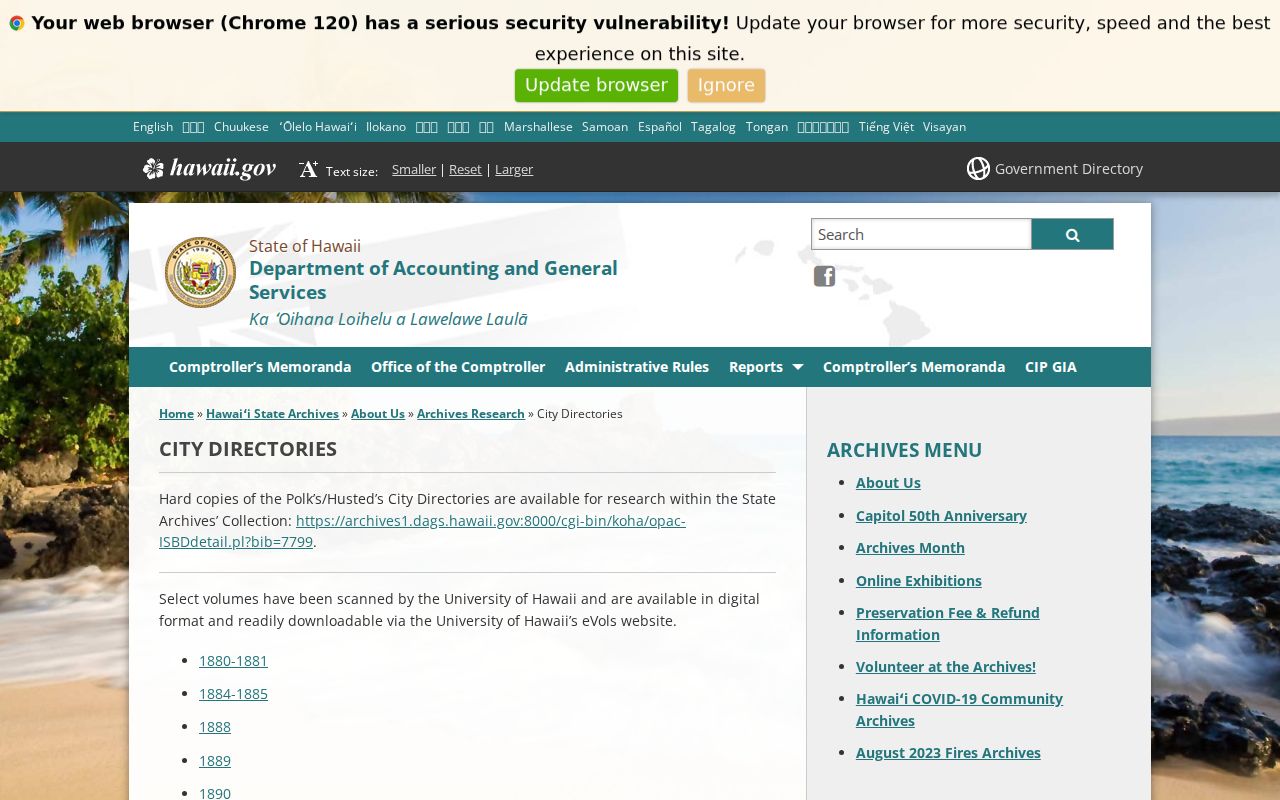
The archive page is the source link for its holdings and access notes; individual scanned editions may instead live through EVols or a catalog partner.
Honolulu's 1908 Directory Shortcut
The 1908 street index is a rare address-first shortcut. Start with the old house number and street, note the listed name, then turn to the alphabetical section to read the full entry. Earlier Honolulu city directories may require the reverse path: find the person first and then record the address. This distinction saves time when a surname is common or when handwriting in another record is unclear.
Insider tip. Photograph the title page and abbreviation key before copying entries, since symbols and geographic scope change by edition.
Street names and numbers may have changed. HSA road files, Sanborn maps, deeds, and permit dates can bridge an old location to a modern parcel. The full modern address workflow belongs in the Honolulu street directory; historical city directory work should preserve the old wording before making that connection.
Note: The research found no verified continuous reverse-directory run beyond street listings and the singled-out 1908 index.
Reading Honolulu City Directory Entries
Copy a Honolulu city directory entry exactly before interpreting it. A useful transcription includes surname, given name or initials, household notation, occupation, employer or firm, street address, page, section, and every abbreviation. Punctuation and shorthand vary by publisher. The EVols item verifies that the 1903–1904 volume contains personal, street, business, advertising, and civic material, but its page image was not available during research, so no sample person or symbol should be invented.
| Name | Surname, given name, initials, and any spouse or household notation actually printed. |
|---|---|
| Work | Occupation, trade, employer, firm, or business association. |
| Address | House number and street as written in that edition. |
| Status marks | Owner, renter, widow, residence, or boarding marks only when the key defines them. |
| Source details | Edition, page, section, spelling, and abbreviation-key meaning. |
- Criss-cross directory
- A directory arranged by street or address rather than only by surname. Honolulu research verifies street listings, especially the 1908 index, but not a continuous reverse series.
- Householder index
- An address-ordered list that can identify the named person associated with a household in that edition.
- Abbreviation key
- The publisher's legend for shortened words and status marks. It often sits near the front and must be read for that exact volume.
A business entry proves a printed link to a firm, not that the site was a home. A telephone entry identifies a subscriber, not every occupant. Even a household entry is an annual snapshot, so one city directory should be checked against adjacent years.
Honolulu Directory Name Variants
Historical Honolulu names may appear with or without the ʻokina and kahakō, under English or Hawaiian spellings, in changed name order, or as initials. Married and maiden forms can split a trail. Preserve the exact printed form, then try unaccented variants, initials, aliases, and alternate spellings. The Hawaiian Historical Society research library specifically supports all-word and alternate-spelling catalog searches.
HHS holds more than 12,000 volumes, about 35 linear feet of manuscripts, nineteenth-century and Hawaiian-language newspapers, maps, pamphlets, and photographs. Research is by appointment at 808-537-6271 or hhsoffice@hawaiianhistory.org. The image below is the successful manifest capture for this research channel.

The catalog can reveal a manuscript, newspaper, annual, or photograph that explains why a directory spelling changed.
Honolulu Telephone Directory Runs
Telephone books extend the Honolulu city directory trail well into the late twentieth century. HSL records Oʻahu holdings for 1894–1928 on microfiche, 1929–1953 Mutual Telephone hard copy, 1954–1979 Hawaiian Telephone, and 1980–2001 GTE. These runs can help fill a missing Polk edition or track a subscriber after annual city directories changed format.
A telephone listing is narrower than a resident roll. It may show a subscriber and service address while omitting other adults, unlisted users, or a person who had no telephone account. Compare the printed address with a city directory, newspaper notice, or later public record. Do not turn the subscriber name into a claim about the whole household.
Honolulu Directory Companion Records
Newspapers, yearbooks, census schedules, probate packets, and cemetery indexes explain the sparse facts in a city directory. The Hawaiian Gazette, Evening Bulletin, and Hawaii Holomua carry advertisements, legal notices, society items, and obituaries. HSL's yearbooks can establish a school-year timeline. HSA's 1878 named Oʻahu census and limited 1896 Honolulu schedules may add age, occupation, marital status, nationality, property, and street detail.
Probate records from 1814–1917, deeds from 1846–1900, and grantor-grantee indexes from 1845–1916 supply heirs, land descriptions, dates, and residence clues. Cemetery routes include Hawaii Digital Archives, Makiki records from 1896–1954, and the Nanette Napoleon index. None is a complete city database.
The successful Hawaii Digital Archives capture links to another official path for historical names and burial records.
Use a result as a lead, then identify the original HSA, BOC, court, or other custodian before requesting an authoritative copy.
Trace Family Through Honolulu Directories
Build a year-by-year table instead of copying one promising entry. Honolulu city directories work best beside local and federal census schedules because the annual volumes fill years between census dates, while census pages may identify a broader household. Keep the old name and address intact until maps or deeds prove a modern match.
- Find the first clear entry and record its exact spelling, initials, work, address, edition, page, and marks.
- Check the prior and next available editions. Note each move, work change, spouse notation, and gap without guessing why it occurred.
- Use the street listing or 1908 index to confirm the address side of the entry, then check maps or road files if numbering changed.
- Pair the timeline with the 1878, partial 1890, limited 1896, or available federal census schedule that fits the period.
- Close the trail with an obituary, cemetery index, probate packet, deed, death index, or later telephone listing.
A person can disappear because of a move, death, missed canvass, changed surname, publication gap, or choice not to list. No entry is proof of none of those. Search both name variants and the old address, then use a dated companion record. For a living person, do not infer private family members from an old household line.